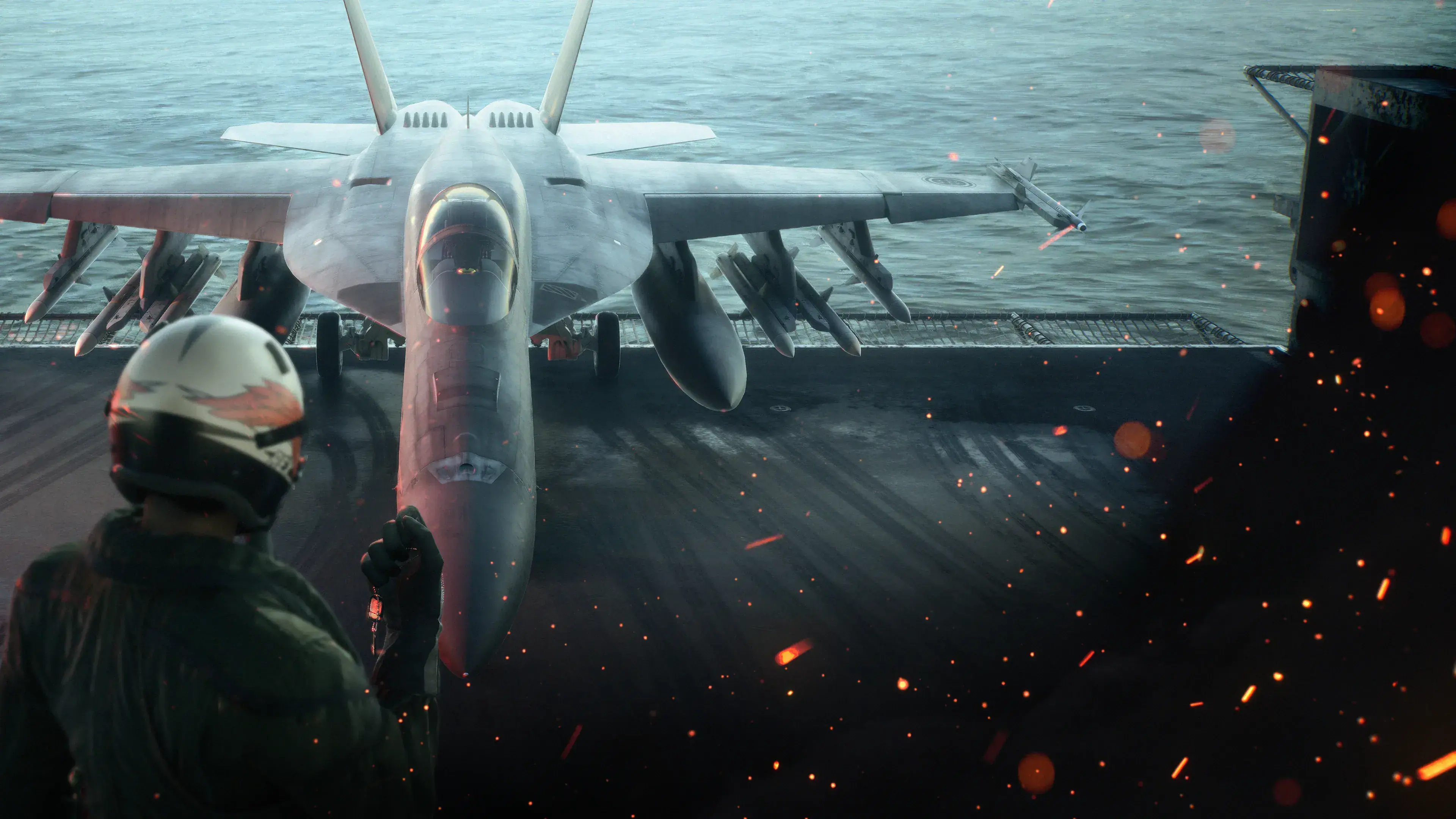
Kate Evans is Lieutenant Commander Katherine Evans, callsign Little Bee, an FCU Navy aviator stationed aboard the carrier Endurance. She begins the story as Queen Flight’s leader and stands out as a disciplined commander who tries to protect the pilots of both Queen and Joker Flights. Her bandages hint at the battles she has already endured, while her calm manner hides the fear and strain she refuses to place on her subordinates.
This guide first covers Kate’s identity and personality without major plot details. Her complete campaign arc, changing relationships, disappearance, return, and final status appear later behind explicit spoiler warnings.
Kate Evans at a Glance

Official character render of Kate Evans.
| Detail | Kate Evans |
|---|---|
| Full name | Katherine Evans |
| Common name | Kate |
| Rank | Lieutenant Commander |
| Callsign | Little Bee |
| Service | FCU Navy |
| Initial command | Queen Flight |
| Base of operations | The carrier Endurance |
| Core role | Pilot, flight leader, and protector of the carrier’s air wing |
Kate is not simply another friendly voice on the radio. As Queen Flight’s commander, she carries responsibility for her own pilots while also watching Joker Flight and the wider battle. Her dialogue repeatedly returns to survival, formation discipline, and the leader’s obligation to bring people home.
That responsibility explains both her strongest qualities and her central internal conflict. Kate can make decisions under pressure and project confidence, but she treats freedom as something other pilots possess more naturally than she does. Where an unconventional ace may improvise without apparent restraint, Kate thinks like a commander: remember the objective, maintain the formation, protect the flight, and accept responsibility for the result.
Kate’s Leadership Style
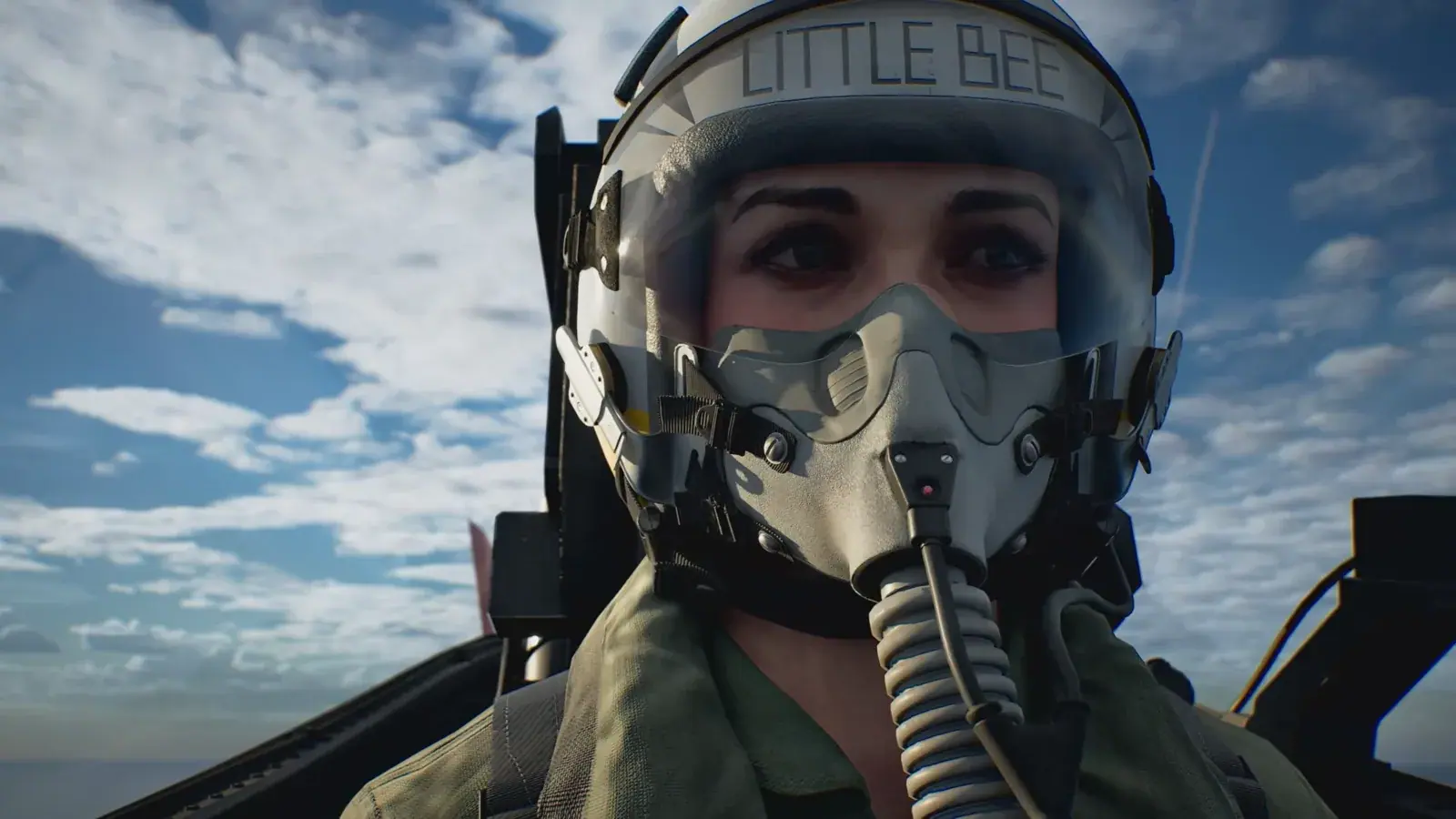
Kate Evans in the cockpit as Little Bee.
Kate’s defining trait is protective leadership. She does everything in her power to preserve the lives of pilots in both carrier flights, and she expects the people under her command to help one another survive. When circumstances deteriorate, she does not indulge defeatism. She asks for workable ideas, gives direct orders, and tries to keep the formation together.
Several recurring behaviors establish how she leads:
- She checks on pilots and friendly forces instead of treating them as expendable pieces.
- She insists that survival comes before ceremony, credit, or celebration.
- She uses clear orders when a scattered formation would place pilots in unnecessary danger.
- She accepts administrative responsibility after battle rather than disappearing once the shooting stops.
- She acknowledges losses instead of masking them with empty optimism.
- She can trust another pilot’s judgment without surrendering her own duty to protect the group.
Kate’s positive attitude is therefore not simple cheerfulness. It is part of how she keeps fear from spreading through the flight. The strain is real, but she chooses to carry it privately so that less experienced pilots can continue functioning. That choice makes her reliable, though it also reinforces the sense that she has confined herself inside her role.
Her skill as a pilot matters because the protection she promises is practical, not ceremonial. She joins dangerous operations, holds off attackers, covers other aircraft, and continues fighting even when the situation has already cost her heavily. Her authority comes from sharing the risk rather than issuing orders from safety.
Visual Markers of Kate’s Identity
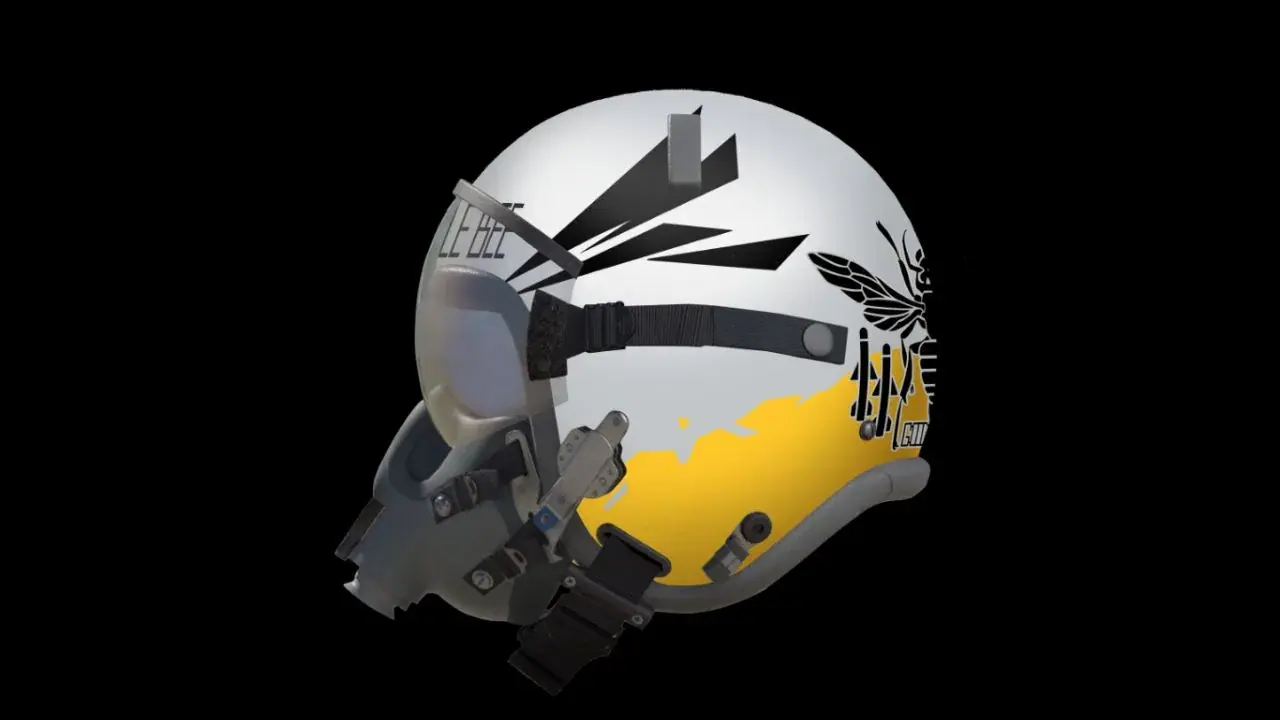
The graphic details on Kate's Little Bee helmet.
Kate is easy to identify by the bandages she continually wears. They signal a history of harsh fighting, but the story does not tie them to one fully explained injury. It is safer to read them as a visible reminder of accumulated hardship rather than proof of a particular unseen event.
Her flight helmet provides another direct link to the Little Bee identity. In cockpit scenes, the helmet and callsign help distinguish the professional combat pilot from the composed officer seen around the Endurance. The contrast is important: Kate’s outward calm does not mean that war has left her untouched.
The callsign Little Bee also fits her role within the larger air wing. She is persistent, mobile, and constantly concerned with the pilots around her. The story does not require a complicated symbolic explanation, however. It is first and foremost her established combat callsign.
Kate’s Full Campaign Arc
Major campaign spoiler warning: The remainder of this guide reveals the destruction of Queen Flight, Kate’s reassignment, her apparent death, her return, and her postwar role.
Queen Flight, Cope, and the Weight of Command
Kate initially flies as Queen 1, leading Queen Flight during the Sotoa-Usea War. Her priority is keeping her pilots alive, but the flight eventually suffers devastating losses. Kate survives while the pilots under her command do not, leaving her with the exact outcome her leadership philosophy was built to prevent.
That loss turns her sense of duty into a burden. She is still capable of commanding and fighting, yet she becomes the sole carrier of Queen Flight’s memory. Her later statements about protecting Wings, recovering personal effects, and continuing even if she is taken down all carry more weight once those losses are understood.
Jan Cope is central to this part of her arc. Kate knew him during training, but the war placed them in different flights, so she did not truly observe his live-combat flying at close range. She remembers him as a uniquely free pilot whose movements seemed impossible to contain. Kate, by contrast, describes her own flying as obedience to an operation and an objective. She envies the freedom associated with the Wings of Theve even while respecting the responsibility attached to that legend.
After Queen Flight’s loss, Kate temporarily joins Joker Flight as Joker 2. She fills the position left open while Baxter undertakes a separate operation. This is more than an administrative transfer: the commander who lost her own flight must now find a place inside another tightly connected group.
Spoiler warning: The next subsection reveals Kate’s shootdown, disappearance, and return.
The Shootdown and Return
During Operation Paint It Blue, Kate is hit and forced to bail out. She is stranded at sea with no friendly forces in sight, and the others have reason to believe she has died. Her apparent loss affects more than Joker Flight’s roster. Kate had become a source of stability for the Endurance’s pilots, so her disappearance removes one of the people most capable of holding the group together.
The campaign briefly leaves her fate unresolved. While close to death, Kate appears to experience or imagine contact with Cope’s spirit. The scene supports an emotional connection between her struggle and Cope’s memory, but it does not require a literal explanation of what she experiences.
Kate survives because Savian mercenaries find her after their Sotoan contracts have expired. The encounter gives her a route back into the war. The mercenaries subsequently fight under an FCU contract, with D.D.’s money supporting the arrangement.
Kate returns during Operation Locust Purge. Her first priority is not rest, recognition, or an explanation of everything she endured. She formally requests permission to rendezvous and return to duty, while making it clear that she will not accept a refusal. She then rejoins Joker Flight as Joker 4 and takes responsibility for covering Tasha.
The return does not erase Queen Flight’s loss or transform Kate into a carefree pilot. It shows that her protective instinct survived the experience that nearly killed her. She resumes the same work with a broader group of allies and a clearer willingness to stand beside the new Wings of Theve.
Spoiler warning: The next subsection reveals Kate’s final status after the main conflict.
Kate’s Final Fate
Kate is alive at the end of the war. After serving as Joker 4 through the conflict’s conclusion, she becomes the leader of King Flight and flies as King 1. During a later surveillance mission over Sotoan territory, Rex occupies the back seat of her aircraft.
This ending matters because Kate does not finish the story as a memorial, a vanished pilot, or a permanent substitute in Joker Flight. She returns to command. The new callsign marks a fresh assignment, while her partnership with Rex shows that the bonds formed during the campaign continue beyond its final battle.
Her callsign progression provides a compact outline of that arc:
| Callsign | Meaning in Kate’s story |
|---|---|
| Queen 1 | Leader of Queen Flight and protector of its pilots |
| Joker 2 | Temporary member of Joker Flight during Baxter’s absence |
| Joker 4 | Her position after surviving the shootdown and returning to combat |
| King 1 | Her postwar command as leader of King Flight |
Kate’s Key Relationships
Relationship spoiler warning: This section discusses how Kate’s connections to Cope, Rex, Tasha, and Joker Flight change across the campaign.
Jan Cope
Cope represents the freedom Kate believes she lacks. They knew one another in training, but separate assignments prevented her from seeing much of his real combat flying. She later gathers impressions from Tasha, who remembers his movements as being like the wind: close enough to feel, but impossible to catch.
Kate carries Cope’s words and habits forward. She recalls his belief that pilots should not bind their own wings, compares Rex’s style to his, and wonders what it would have been like to fly with the same freedom. Cope’s importance to her is therefore professional, personal, and symbolic. He is a lost peer, a standard she cannot reproduce, and a reminder that duty need not completely extinguish individuality.
Rex
Kate initially approaches Rex as a commander evaluating the new Wings of Theve. Over time, respect replaces uncertainty. She sees that Rex has developed an identity rather than merely copying Cope, even though something in his flying still reminds her of the earlier ace.
When Kate joins Joker Flight, she accepts a supporting role and commits herself to protecting Rex. This is not a surrender of authority. It is a conscious choice to place her experience behind the pilot carrying the larger legend. Her later return reinforces that choice: she asks to rejoin the fight under Rex’s command instead of demanding her old position back.
The postwar King Flight scene reverses the arrangement without erasing the partnership. Kate is once again the flight leader, while Rex flies with her. Their relationship ends as one between trusted veterans rather than commander and replacement.
Tasha and Joker Flight
Kate’s relationship with Tasha combines protection, curiosity, and shared memory. She promises to cover Tasha after returning, but she also asks Tasha to describe how Cope flew. Tasha can supply the perspective Kate missed because she and Cope were assigned to different flights.
Joker Flight gives Kate somewhere to continue after Queen Flight’s destruction. At first she is filling an empty position. After her return, she becomes part of the group on her own terms. The shift from Joker 2 to Joker 4 distinguishes those stages: first a stand-in, then a surviving pilot who actively chooses to come back.
What the Five Wings Symbol Means
Spoiler warning: This section discusses a campaign symbol connected to Joker Flight and Cope.
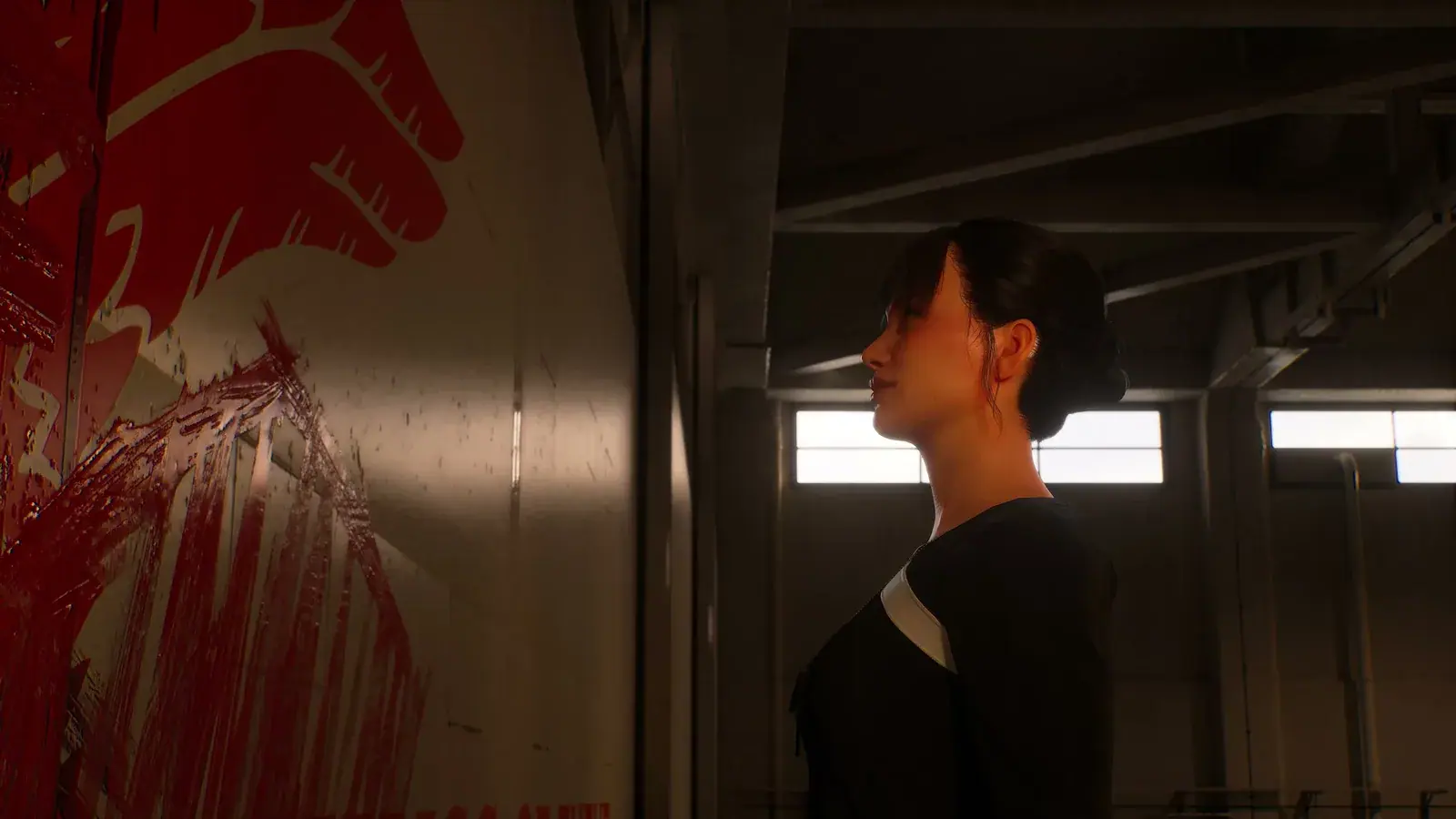
Kate beside the red Five Wings wall painting.
Kate’s Five Wings sigil turns the campaign’s idea of inherited responsibility into a visible emblem. The dialogue associates the emblem with Joker Flight and Kate together: four pilots in Joker Flight, with Kate joining them as the fifth. This reading gives Kate a place beside the pilots whose formation she is joining.
The dialogue also allows another reading: the fifth wing may represent Cope. Under that interpretation, the fallen ace remains part of the formation through the people carrying his influence forward. The campaign does not force the two meanings to compete. The emblem can represent the living flight while also preserving the place of the pilot whose example helped shape it.
That ambiguity fits Kate particularly well. She does not escape grief by forgetting Queen Flight or Cope. She converts memory into a reason to protect the pilots still beside her. By the end, her defining quality is not that she became as free as Cope or as legendary as Rex. It is that repeated loss did not stop her from leading, trusting another pilot, and returning to the sky.