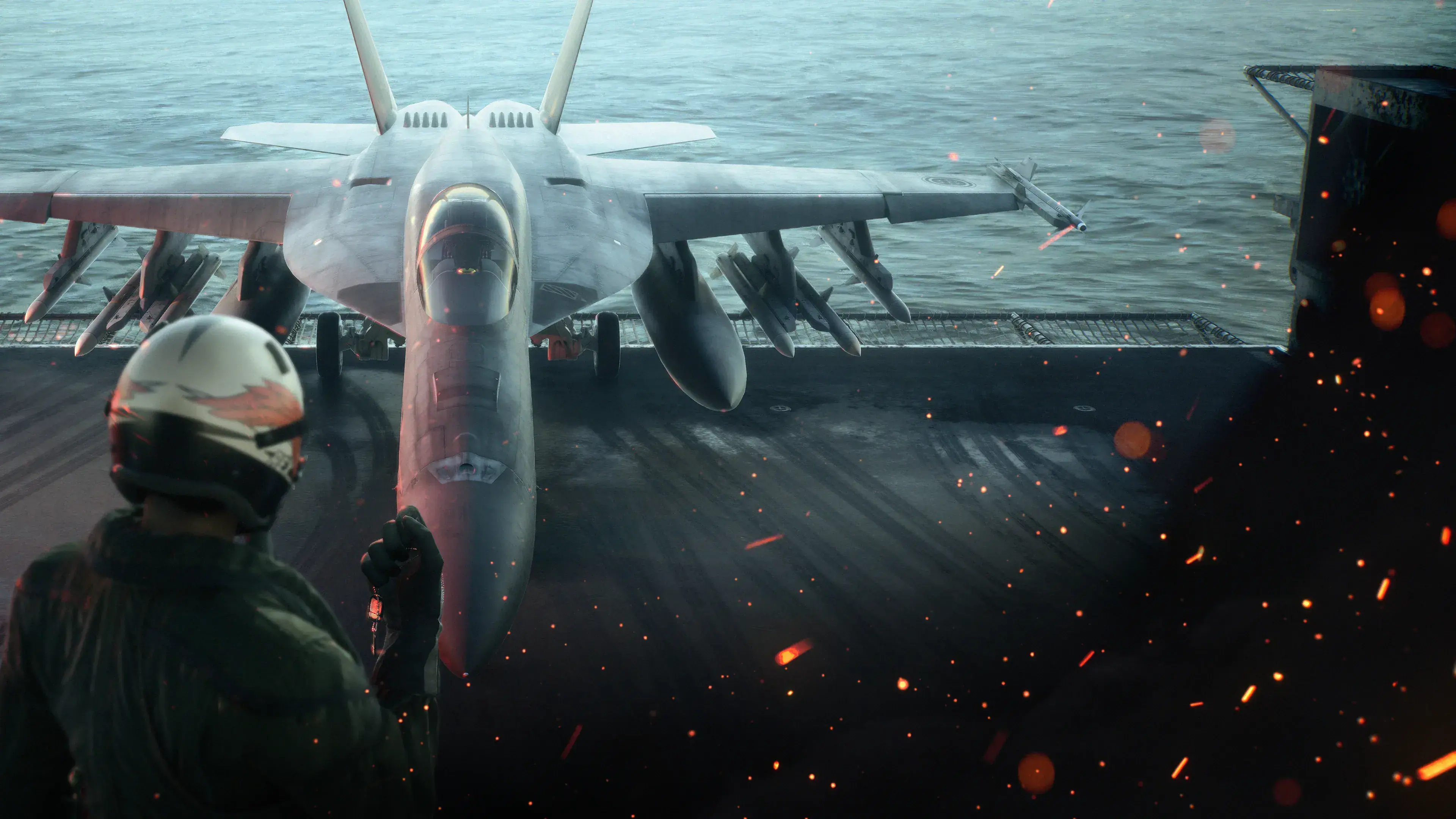
The best plane in Ace Combat 8 is the F-35C for a flexible first-campaign hangar, but it is not the strongest answer to every sortie. Its multirole role and carrier compatibility make it a safe late-game destination when you want one aircraft for mixed air and surface objectives. Choose the F-22A when air superiority is the clear priority, the F-15E Strike Eagle for sustained ground clearing, and the Rafale M or a Super Hornet when you need a versatile carrier aircraft.
That recommendation is a decision framework, not a promise that one aircraft will automatically clear missions or earn higher ranks. Your special weapons, upgrade parts, route knowledge, and ability to finish the sortie matter as much as the airframe. Campaign and ACE COMBAT ONLINE also use separate progression, so a campaign recommendation should not be treated as a universal multiplayer tier list.
Use the aircraft roster to check role and availability, the Aircraft Tree for prerequisites, and the MRP guide for the complete spending plan.
Version scope — October 7, 2026: This page was edited from supplied research. No numbered game build or independent playtest is recorded for this guide. Check the current in-game descriptions and your platform before applying build-sensitive conditions.
Best plane by role at a glance
| Your main goal | Recommended plane | Why it fits | Important limitation |
|---|---|---|---|
| One high-end campaign aircraft | F-35C Lightning II | Multirole aircraft that can operate from carriers and cover both aerial and surface objectives | Its 550,000 MRP aircraft price is only the final-node cost; prerequisite nodes raise the real investment |
| Air-to-air combat | F-22A Raptor | High-end Fighter built around speed, maneuverability, and air superiority | A mission dominated by ground or naval targets may reward a more specialized loadout |
| Ground-heavy missions | F-15E Strike Eagle | Attacker with strong strike capability while retaining credible air-combat performance | It arrives later than early options such as the F-2A |
| Flexible carrier missions | Rafale M | Carrier-capable Multirole with long-range air and surface attack options | It is not the cheapest route if you are already progressing through another branch |
| Practical mid-campaign workhorse | F/A-18E or F/A-18F Super Hornet | Carrier compatibility and mixed-target usefulness make the family easy to keep using | The E and F have different weapon coverage, so check the mission rather than treating them as identical |
| Early campaign without extra spending | F/A-18C Hornet | Free starting Multirole with tools for aircraft, ground targets, and ships | Later aircraft offer stronger performance and broader build options |
| Wingman support | EA-6B Prowler or EA-18G Growler | Electronic-warfare support can improve the flight’s overall effectiveness | Their value is tactical; they are not direct-damage replacements for every fighter or attacker |
Why there is no universal best aircraft
Ace Combat 8 divides aircraft into Fighter, Attacker, Multirole, and Electronic roles. Those labels are useful because they describe what an aircraft is designed to do, but they are not hard restrictions. Fighters can have ground-attack options, Attackers can defend themselves against aircraft, and Multiroles trade peak specialization for the ability to respond when a mission changes target type.
A useful ranking therefore starts with the sortie rather than the aircraft price. Ask what can make the mission fail: being unable to catch aircraft, running short of suitable weapons against surface targets, bringing a land-based favorite to a carrier-restricted operation, or choosing a specialist that cannot adapt when the objective changes. The plane that removes that failure point is the best plane for that mission.
This is also why community favorites vary widely. Players report completing large parts of the campaign with Hornets, Super Hornets, the Su-33, the F-35C, the F-22A, dedicated Attackers, and other branches. That spread supports a practical conclusion: aircraft choice matters, but there is no evidence that every player must follow one absolute tier list.
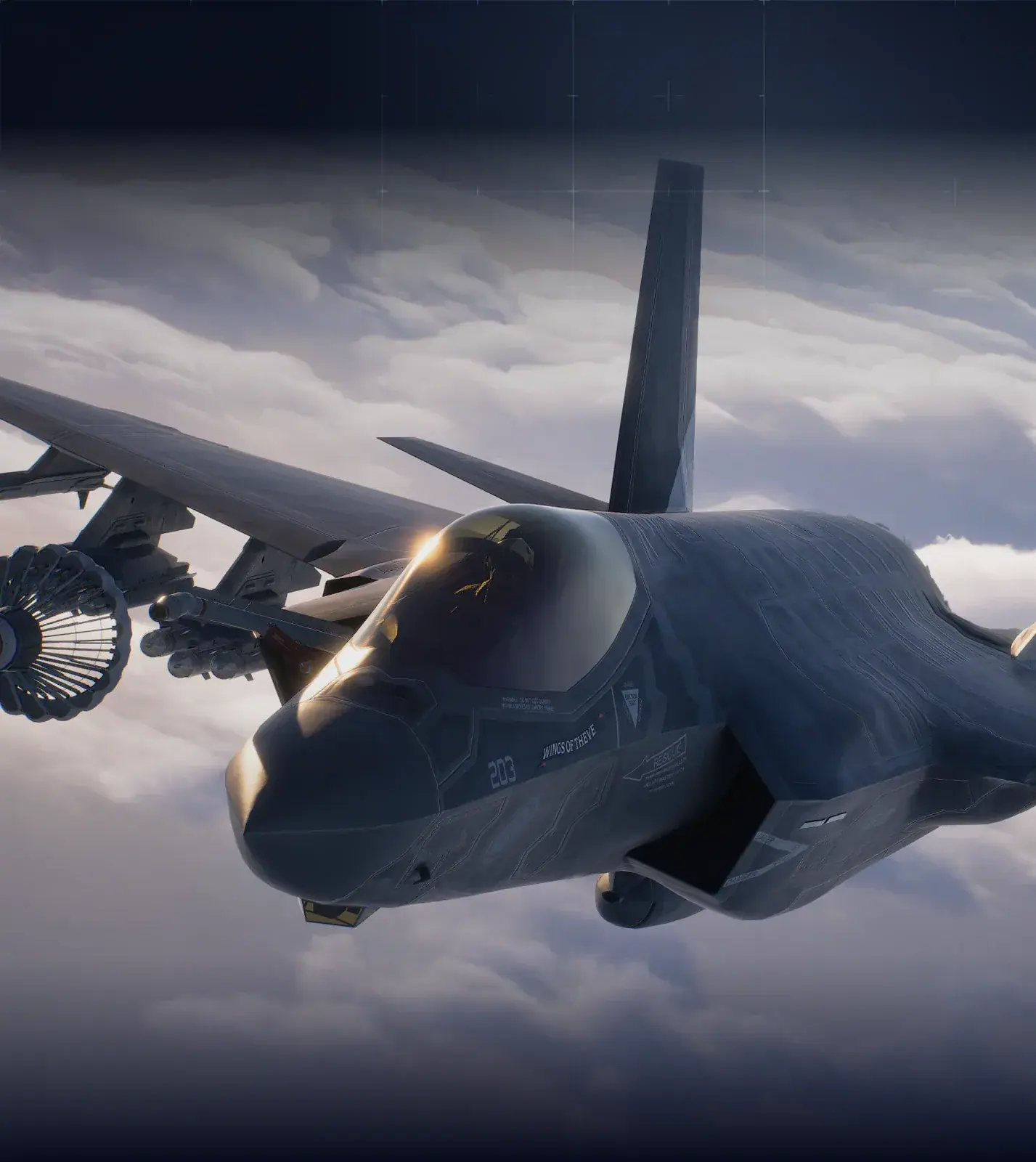
Best overall campaign choice: F-35C Lightning II
The F-35C is the strongest default recommendation when you want one late-game destination instead of buying across several disconnected branches. It is a Multirole aircraft, it can operate from a carrier, and its available weapon coverage supports aerial combat, long-range surface attacks, and groups of ground targets. That combination reduces the number of missions in which your airframe choice itself becomes the problem.
The route is also coherent for a first campaign. It begins with the free F/A-18C and continues through useful multirole and electronic-warfare aircraft before reaching the F-35C. The listed aircraft purchases on this path are:
- Keep the free F/A-18C Hornet while inspecting the Aircraft Tree.
- Buy the Mirage 2000-5 for 130,000 MRP.
- Choose an F/A-18E or F/A-18F Super Hornet for 240,000 MRP.
- Continue through the EA-18G Growler for 350,000 MRP.
- Buy the F-35C Lightning II for 550,000 MRP.
Those aircraft alone total 1,270,000 MRP after the free Hornet. The actual route costs more because connecting special weapons and upgrade parts must also be purchased. Treat 1,270,000 as the aircraft subtotal, not a complete unlock budget.
The F-35C is not automatically the right purchase if you only enjoy fighter combat or already committed heavily to another branch. In that case, forcing a new route can cost more than improving an aircraft you already fly well. It is the safest general recommendation, not a guaranteed optimal answer for every player.
Best air-to-air plane: F-22A Raptor
Choose the F-22A when the briefing points toward interception, dogfighting, bosses, or a sky crowded with hostile aircraft. The official aircraft description emphasizes its maneuverability and superiority in air combat, while its available special weapons give it both focused and multi-target aerial options. It also has a ground-attack option, so selecting it does not make every surface target untouchable.
The F-22A costs 550,000 MRP at its aircraft node, but you must reach it through its branch. Inspect the complete route before spending. If the Raptor is your real goal, a focused F-22 path is better than buying an F-35C merely because it is a broader all-rounder.
Do not interpret “best air-to-air” as “best for every mission containing aircraft.” Mixed sorties can still favor a Multirole, especially when the decisive objective is on the ground or at sea. The F-22A becomes the clear recommendation when aerial threats are the central problem rather than one part of a varied target list.
Best ground-attack plane: F-15E Strike Eagle
The F-15E is the most practical recommendation for a ground-heavy campaign mission that may still turn into an air fight. Its Attacker role, heavy weapon capacity, and strong basic air-combat capability give it a useful balance between specialization and self-defense. Its strike options can address both concentrated targets and more dispersed ground groups, so it is easier to adapt than a plane built only for one attack pattern.
Community reports repeatedly single out the F-15E as a later-campaign ground clearer that can still dogfight when required. Treat that as practical player guidance rather than a guaranteed damage or clear-time result. Your chosen special weapon still has to match the actual target layout.
The Su-34 Fullback is a strong alternative when you want a heavier dedicated strike aircraft, while the F-2A is a useful earlier option with particular value against surface and naval targets. The A-10C and Su-25SM can be effective in ground-dominated battles, but their lower speed makes them less comfortable when the mission demands rapid movement across a large combat area or a sudden transition to aerial pursuit.
Best carrier plane: Rafale M or Super Hornet
Carrier restrictions can turn an excellent land-based aircraft into the wrong purchase for part of the campaign. If you want a carrier-capable plane that remains useful against varied targets, the Rafale M is a strong all-round choice. It combines maneuverability with long-range options against both aircraft and surface targets, making it suitable when the briefing does not reveal a single dominant target type.
The F/A-18E and F/A-18F Super Hornets are more natural choices if you are already following the F-35C route. Players frequently describe the Super Hornet family as a campaign workhorse because it remains usable across carrier missions and mixed objectives. The two variants should still be compared by their special weapons: choose the one whose tools match the sortie instead of assuming the letters are cosmetic.
The Su-33 and F-14D are better fits when you want a carrier aircraft that leans more strongly toward fighter work. The starting F/A-18C also remains a valid fallback. Keeping it saves MRP and prevents you from buying a separate carrier aircraft solely to satisfy a mission restriction.
Best early plane and first-campaign spending strategy
The free F/A-18C is the best early answer for many players because buying a replacement immediately is unnecessary. It is a carrier-capable Multirole, and its weapon choices cover aircraft, ordinary ground targets, and ships. Use it while you learn which combat role you actually enjoy and examine where each Aircraft Tree branch ends.
Avoid buying every inexpensive aircraft as soon as it appears. A cheap node on the wrong branch still delays your chosen destination, and the printed price of a late aircraft does not include all prerequisite planes, weapons, and parts. A simple first-run plan is more reliable:
- Pick one high-end destination such as the F-35C, F-22A, or Su-57.
- Trace the required nodes backward to the aircraft you already own.
- Prefer connecting weapons and parts that improve planes you will actually fly.
- Add a specialist only when a mission exposes a real gap in your hangar.
- Leave unrelated branches for later campaign runs or Free Mission play.
You also receive the A-6E Intruder after clearing Mission 14, giving you a dedicated Attacker without a normal Aircraft Tree purchase. That reduces the need to buy an early Attacker merely because ground targets exist.
How to choose the right plane before each sortie
Use this checklist rather than defaulting to the aircraft with the highest price:
- Check the operating restriction. If the mission requires a carrier aircraft, remove incompatible choices before comparing performance.
- Identify the target that controls success. Numerous optional ground targets do not necessarily make an Attacker best if the decisive phase is an aerial interception.
- Match the special weapon to target density and range. A weapon for clustered ground targets solves a different problem from long-range missiles or multi-target air-to-air weapons.
- Plan for mission changes. When the target mix is uncertain, a Multirole is usually the safer recommendation.
- Account for ammunition and mission length. A theoretically powerful loadout is less useful if it cannot sustain the objectives you intend to attack.
- Use the whole flight. A wingman in an Electronic aircraft can provide support while you fly the direct-combat aircraft that best fits the objective.
- Favor consistent clears over theoretical peak output. Mission rewards and progression depend on completing sorties, so an aircraft you control reliably can be more useful than a demanding high-end option.
Electronic aircraft are often better on a wingman
The EA-6B Prowler and EA-18G Growler should not be judged only by direct damage. Their electronic-warfare role is built around interference, reconnaissance, defense-network handling, and support. That makes them valuable additions to the flight even when you prefer to pilot a Fighter, Attacker, or Multirole yourself.
A practical campaign setup is to give an Electronic aircraft to a wingman while you choose the airframe that handles the mission’s main targets. This is advice, not a guaranteed performance increase for every encounter: the result still depends on positioning, commands, target mix, and how the battle develops. If the mission demands maximum direct firepower from every aircraft, another composition may fit better.
Campaign and online recommendations are separate
ACE COMBAT ONLINE has progression separate from the campaign, so campaign purchases and MRP planning do not transfer into a ready-made online hangar. Online modes also introduce team composition, opposing players, NPC targets, and support roles that can change an aircraft’s value.
For that reason, use the F-35C recommendation as a campaign and general-purpose answer. Do not assume it is automatically the best PvP plane or that a campaign Aircraft Tree route will unlock the same online options. In team modes, an Electronic aircraft or a specialized interceptor may contribute more than another general-purpose plane, depending on the objective and the rest of the squad.