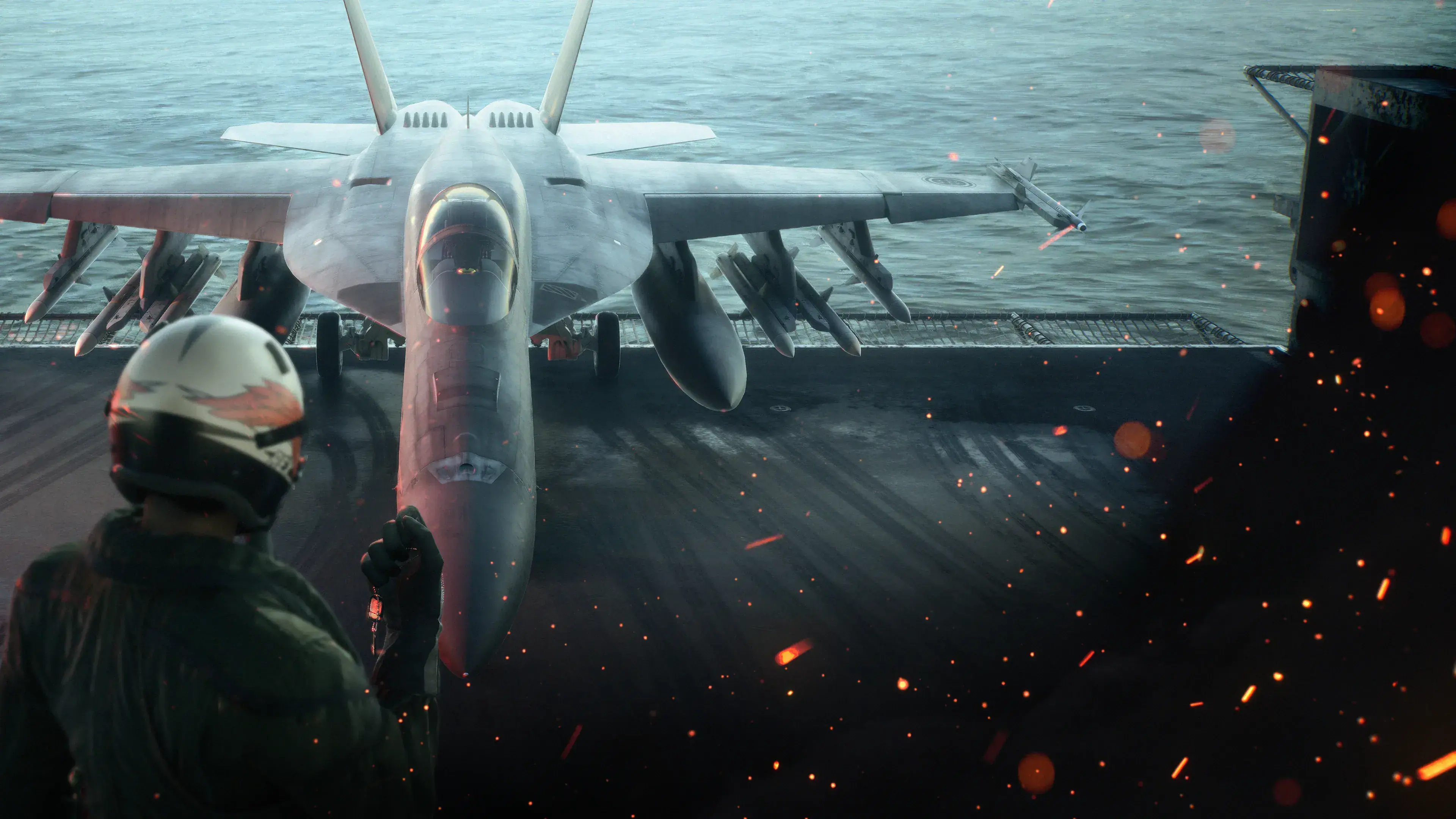
This review combines published assessments with documented game features to help you judge the purchase.
Ace Combat 8: Wings of Theve is easiest to recommend for its single-player campaign. It combines responsive arcade flight combat, rapidly changing missions, useful wingman commands, dramatic presentation, and a story that treats your squadron as more than voices on the radio. It is approachable enough for a first Ace Combat game, but its speed, target prioritization, aircraft handling, and loadout decisions leave substantial room to improve.
The important limitation is that this is not a realistic flight simulator. Its appeal comes from cinematic dogfights, exaggerated military hardware, enormous battles, and melodrama. The Online mode broadens the package with cooperative and competitive activities, but separate progression, layered menus, upgrade requirements, and reported connection problems make it less immediately convincing than the campaign. Buy it primarily for the solo experience; treat multiplayer as additional value rather than the sole reason to purchase.
The short verdict
| Area | Assessment | Buying implication |
|---|---|---|
| Flight combat | Accessible at first, demanding when battles become crowded | Strong fit for action players, not simulator purists |
| Campaign | Varied missions, escalating objectives, and strong spectacle | The main reason to buy |
| Story | Character-focused, earnest, and deliberately melodramatic | Effective if you accept the series tone |
| Progression | Meaningful aircraft, weapon, and part choices, but some desired unlocks take time | Rewarding for experimentation; less appealing if you dislike trees and currencies |
| Multiplayer | Multiple cooperative and competitive formats with separate progression | Substantial extra mode with more friction than the campaign |
| Presentation | Detailed aircraft, layered clouds, forceful sound design, and a prominent soundtrack | A major part of the experience rather than surface decoration |
The overall recommendation is positive, with conditions. Ace Combat 8 is a strong purchase for players who want a substantial, story-driven arcade air-combat campaign. Players interested only in frictionless competitive multiplayer, strict realism, or quiet mission pacing should examine those compromises before buying.
Flying and combat feel
Ace Combat 8 places you in real-world-inspired military aircraft but uses them in an intentionally exaggerated action game. You lock missiles, manage speed, line up gunfire, evade incoming attacks, and switch between air and surface targets while radio calls and warning tones compete for attention. The basic interaction is easy to understand; the challenge is maintaining awareness when several threats and objectives arrive together.
The available control approaches accommodate different comfort levels. A more direct scheme makes initial flight easier, while the fuller pitch, roll, and yaw approach gives you more control over positioning and turns. Neither converts the game into a simulation. Even so, learning when to commit to a turn, how to retain useful speed, and how to settle behind a target creates a real mastery curve.
Aircraft selection also changes how aggressively you can maneuver and what targets you can handle efficiently. Special weapons can favor groups of aircraft, ships, or dispersed ground targets, so the briefing and expected objective mix matter. That preparation rarely replaces flying skill, but it can turn a chaotic sortie into a manageable one. Because missions may introduce an unexpected air battle after a ground attack, a narrowly specialized loadout can become uncomfortable even when it looked ideal at launch.
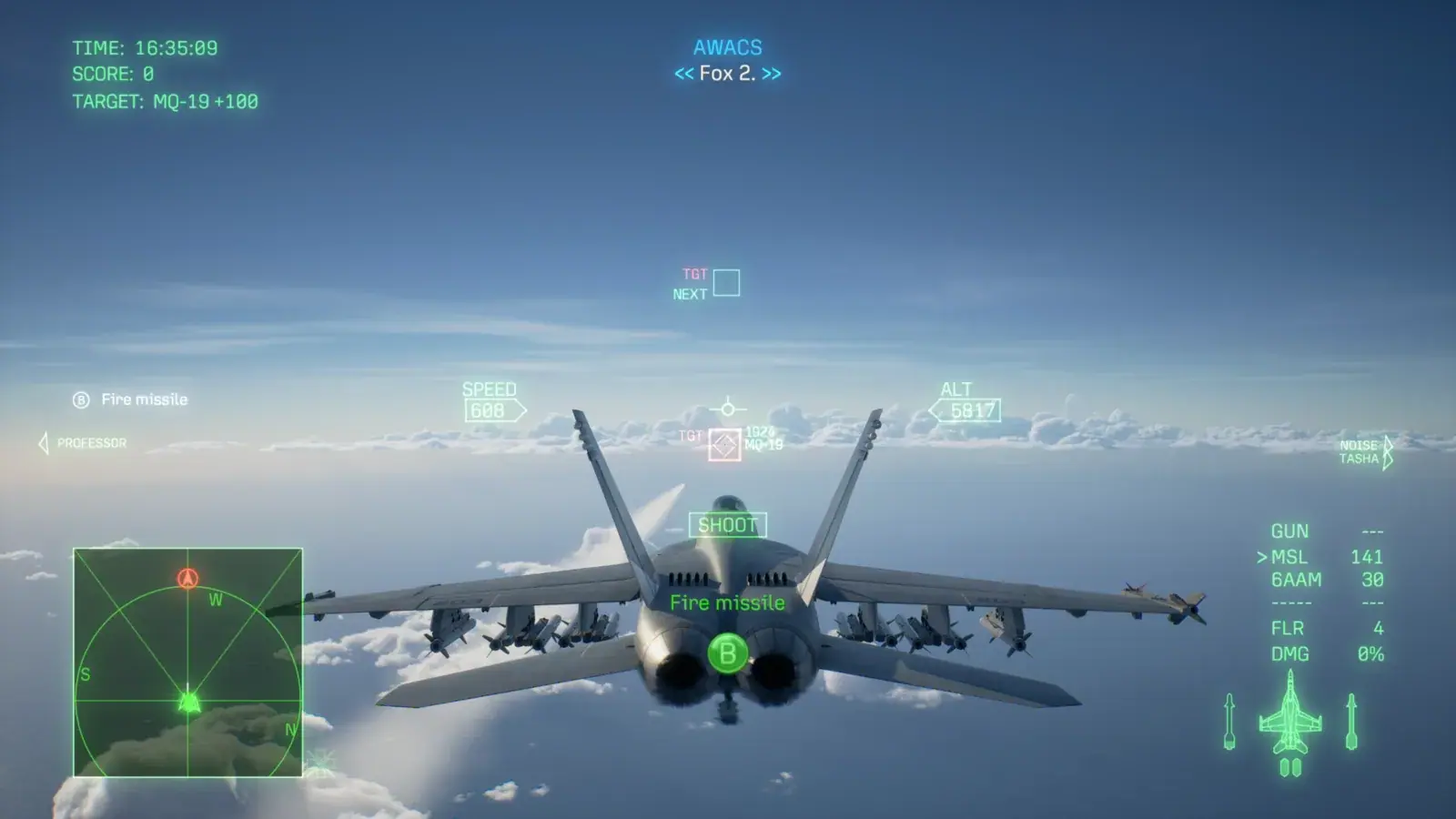
The chase-camera HUD keeps targets, weapons, and missile timing readable during arcade combat.
Mission design is the campaign's biggest strength
The campaign contains 30 missions built around familiar air-combat tasks: intercept aircraft, destroy facilities, protect allies, escort important assets, support ground forces, and attack large targets. The variety comes from how those tasks escalate and overlap. A straightforward opening objective can expand into a crowded battle with new threats, altered priorities, environmental complications, or a rival formation entering the field.
That structure keeps the campaign from feeling like a sequence of identical target lists. You may need to decide whether an endangered allied unit requires immediate help, whether your squadron should attack independently, or whether preserving special ammunition is more important than clearing the current group quickly. The game frequently asks for adaptation after takeoff instead of letting the briefing describe the entire mission.
Large-scale encounters provide the campaign's clearest spectacle. Oversized weapons and heavily armed targets are divided into components, letting you dismantle defenses while managing ordinary aircraft and surface fire around them. Destruction, debris, clouds, contrails, and changes in altitude make these battles readable as events rather than merely larger health bars.
The same ambition creates pressure. Later sorties can be long, checkpoints are not equally forgiving, and failure may require replaying a meaningful portion of a mission. Damage persists unless a mission provides an opportunity to resupply, and special-weapon ammunition can disappear quickly. The resulting tension is part of the campaign's appeal, but players who strongly dislike losing progress should not mistake the accessible controls for an effortless game.
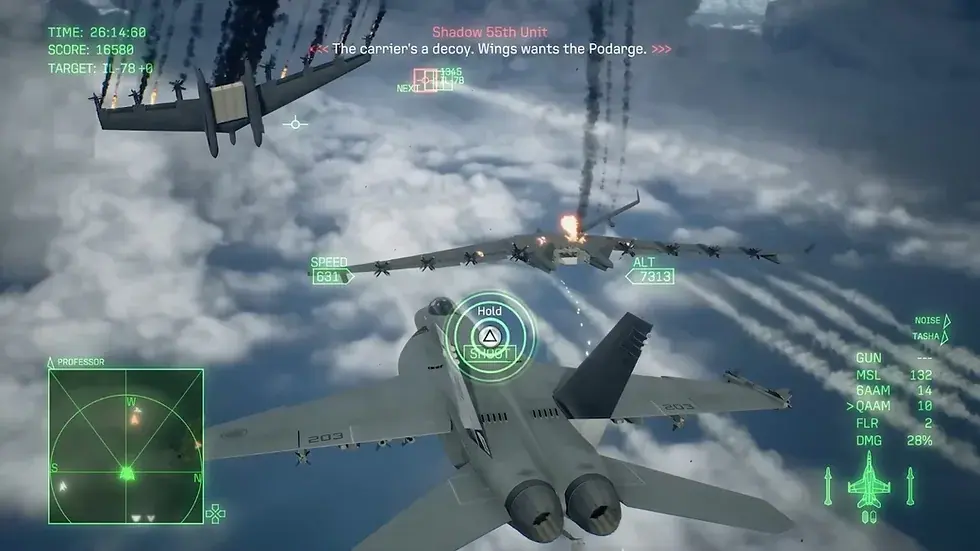
Airborne transport targets appear among the threats tracked during a large battlefield encounter.
Story, characters, and presentation
The story is set in Strangereal, where the Federation of Central Usea is fighting to reclaim territory from the Republic of Sotoa. You fly with Joker Flight aboard the Endurance and carry the symbolic identity of the Wings of Theve. That identity, and the way institutions turn a pilot into a public legend, gives the campaign a theme beyond simply winning battles.
You do not need to know Ace Combat 7 to follow the central conflict. The campaign spends time with the crew outside combat through first-person sequences on the carrier, then continues character development through radio exchanges during missions. Baxter, Tasha, Coster, and the wider supporting cast respond to battlefield events, argue, encourage one another, and give allied losses more weight than anonymous objective markers would.
This approach works best if you enjoy earnest military melodrama. The dialogue can be theatrical, the plot carries many names and allegiances, and the out-of-cockpit scenes deliberately slow the pace between sorties. Some assessments found those scenes emotionally effective; others regarded them as overlong or overly cheesy. That difference is a matter of taste, not a minor detail. Anyone wanting uninterrupted aerial action may find the storytelling intrusive, while players who value a defined squad and a personal stake in the war are more likely to see it as a strength.
The audiovisual presentation supports both sides of the game. Detailed aircraft, dense environments, layered clouds, sonic booms, explosions, warning sounds, radio chatter, and a soundtrack that rises with the action make sorties feel larger than their objective lists. Clouds can also obscure terrain and targets, so the visual design sometimes affects judgment rather than serving only as scenery.
Aircraft progression and wingmen
Campaign progression links mission performance to MRP, which is used to expand your available aircraft, weapons, and parts. The system gives you reasons to replay sorties and experiment, but it also means a desired aircraft may sit behind earlier purchases. Players who enjoy planning a route through an aircraft tree will find a useful long-term goal; players who want immediate access to every jet will encounter friction.
Preparation includes more than choosing the player's aircraft. You can configure the squadron's planes or allow an automatic assignment, then issue simple commands during battle. Wingmen can attack, cover you, or use limited special weapons. Their usefulness makes command timing part of the action: sending them toward a distant problem can relieve pressure, while keeping them close can provide protection during a difficult engagement.
This is not a tactical command game, and the squad will not solve every objective for you. The system matters because it adds one more decision to target selection without burying flight combat under menus. It also reinforces the story's emphasis on Joker Flight as a working unit. Exact aircraft routes, individual unlock costs, and optimal builds deserve dedicated treatment; for a buying decision, the key point is that progression and squad configuration meaningfully affect how you approach repeated missions.
Multiplayer adds value but also the biggest caveats
ACE COMBAT ONLINE uses progression separate from the campaign and supports cross-platform play. Its activities include Co-Op Assault, where two four-player teams attack NPC forces while competing for score; Co-Op Warfare, which combines opposing teams with air, ground, and sea NPC units; the four-player cooperative Scramble; and eight-player Emergency Sorties against large special targets. These are online operations, not a cooperative version of the story campaign.
The range of formats is useful because players can choose between direct competition, score competition with computer-controlled targets, and fully cooperative challenges. Less experienced pilots can still contribute by attacking NPC objectives instead of winning every dogfight. Emergency Sorties add a larger team objective, although access may follow regular online missions rather than being freely selectable whenever you want.
The drawbacks are structural. Online mode has its own aircraft growth, blueprints, materials, currency, and pass progression. This gives regular players goals, but it can also produce a gap between a new pilot and opponents with stronger aircraft or special weapons. Menus and party setup have also been described as needlessly layered, making it harder to reach the enjoyable part: flying a match.
Reported crashes, disconnects, and matchmaking experiences vary among published reviews and player reports, so they do not support a blanket claim that online play will either fail or run perfectly for every buyer. They do justify caution if multiplayer is your only interest. The campaign is the more dependable foundation for the recommendation, while Online is better viewed as a potentially long-lived companion mode with additional grind and launch-period uncertainty.
The weaknesses that may change your decision
Ace Combat 8's shortcomings cluster around pacing and friction rather than its central act of flying.
- The series formula remains recognizable. Missions are polished and frequently inventive, but their building blocks are still dogfights, bombing runs, escorts, defense, and score-driven operations. Longtime players may see refinement more than reinvention.
- Mission intensity can become exhausting. Objectives change quickly, allies demand help, warnings overlap, and the correct priority is not always obvious. That controlled chaos is exciting when you recover, but frustrating when a long attempt ends late.
- Story scenes interrupt the action. First-person carrier sequences strengthen the cast and show the human cost of the conflict, yet their limited interaction and deliberate pacing will not satisfy everyone.
- The tone is unapologetically melodramatic. The game pairs serious anti-war concerns with heroic pilot mythology, huge fictional weapons, theatrical rivals, and frequent radio dialogue. Players need some tolerance for that mixture.
- Progression is not frictionless. Aircraft trees, parts, currencies, and separate online growth reward investment but delay access to some of the equipment players may want most.
- Technical reports are not uniform. Some PC impressions describe strong performance, while other material reports demanding settings, crashes, or disconnects. Those conflicting experiences are not enough to promise a universal platform result.
None of these points erases the quality of the air combat. They explain why the recommendation depends on whether you want the complete Ace Combat mixture rather than dogfighting in isolation.
The right buyer for Ace Combat 8
Buy Ace Combat 8 now if you want a polished arcade flight shooter with a substantial solo campaign, frequent set pieces, aircraft customization, active wingmen, and a story that commits to its characters. It is also a sensible entry point if you have never played the series: the central narrative is understandable without prior homework, and the control options let you begin with a more approachable flight model before pursuing finer control.
Consider waiting if your main interest is competitive Online progression, especially if currencies, passes, and aircraft upgrades undermine the appeal of jumping directly into evenly equipped matches. Waiting is also reasonable if your platform choice depends on a specific performance target; performance reports do not establish one consistent technical result across hardware.
Skip it if you require realistic avionics and weapon behavior, dislike mission timers and late objective changes, or want a campaign that stays restrained and naturalistic. The game is built around the fantasy of becoming a decisive ace inside enormous, improbable battles. Its emotional story and mechanical excitement both depend on accepting that premise.
For the intended audience, the campaign is strong enough to carry the purchase by itself. Online mode, mission replay, higher ranks, additional aircraft, and alternate loadouts extend the value, but they are secondary to the first journey through Joker Flight's war. The safest conclusion is therefore straightforward: Ace Combat 8 is worth buying for arcade air-combat players who want cinematic missions and a committed story, while multiplayer-only and simulation-focused buyers should approach it more cautiously.