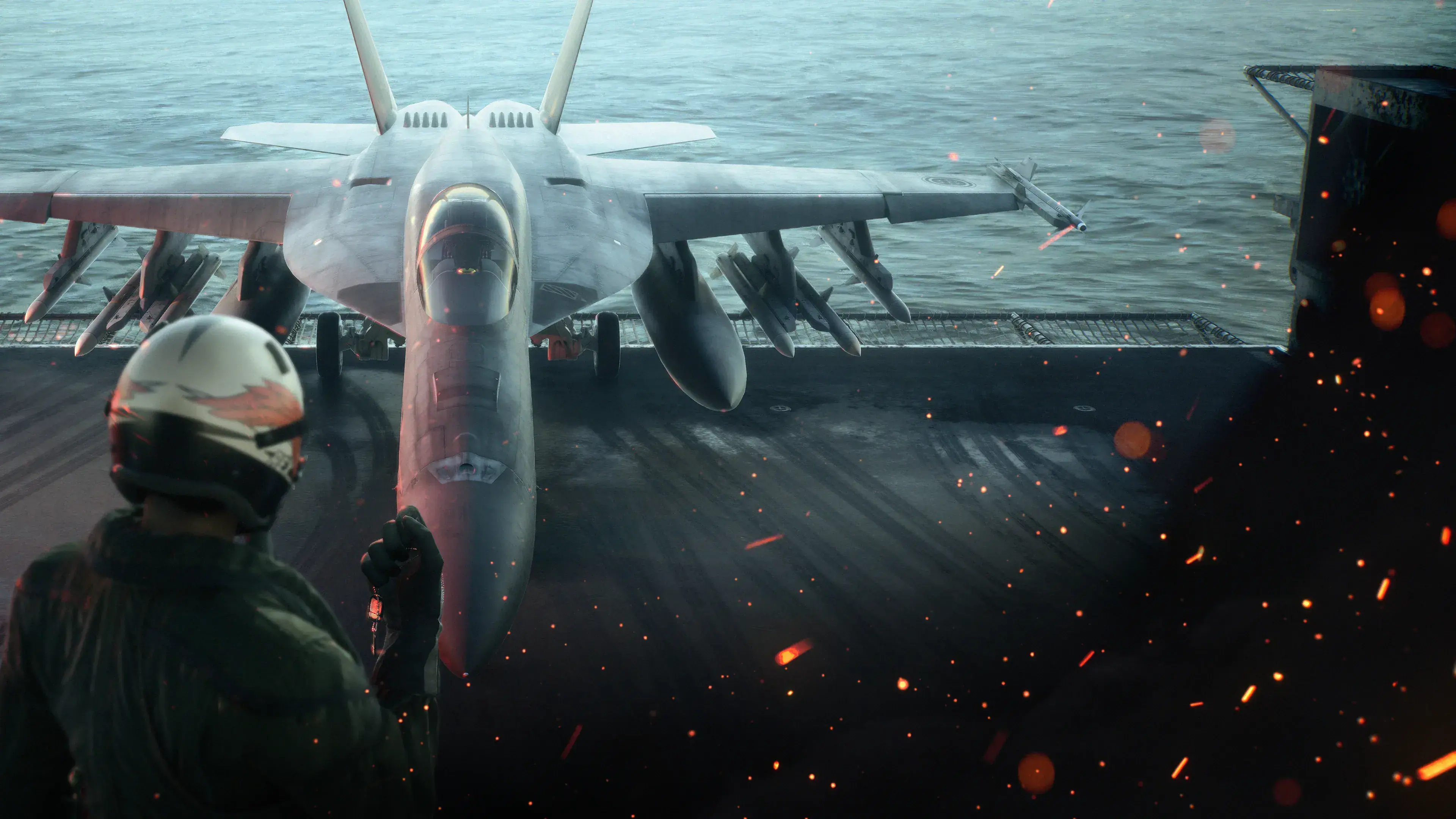
ACE COMBAT 8 Hour Zero is the official live-action prequel to ACE COMBAT 8: WINGS OF THEVE. It is a short narrative miniseries, not a game mode, campaign mission, or edition bonus. Its three episodes follow a pilot, a doctor, and a news anchor during the opening phase of Sotoa’s invasion of the Federation of Central Usea. An epilogue then brings those separate stories toward the beginning of the game’s campaign.
For a first viewing, watch Episode 1, Episode 2, Episode 3, and then the Epilogue. That release order is intentional: the three main episodes move backward through the war until they reach the attack that started it. The epilogue returns to the later point in the timeline and provides the bridge toward the campaign.
Watch the series for free through Bandai Namco Europe's Films & series collection, under ACE COMBAT 8: WINGS OF THEVE | Live-Action HOUR ZERO. Select the numbered episodes and Epilogue there; the similarly named behind-the-scenes entries are optional production videos.
What ACE COMBAT 8 Hour Zero is
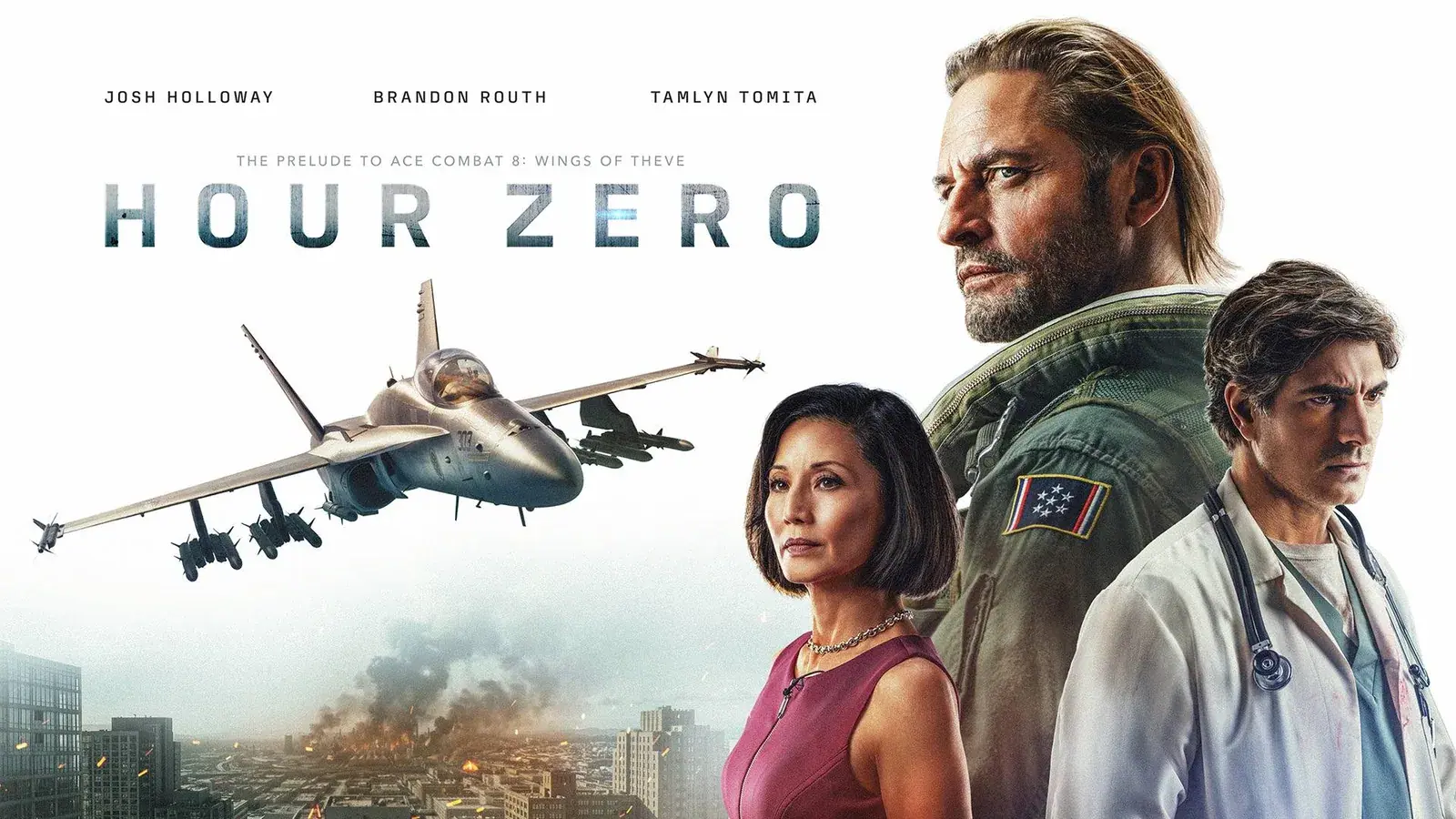
Hour Zero is designed as an introduction to the people, countries, and emotional stakes surrounding ACE COMBAT 8. Instead of following the player-controlled ace, it focuses on civilians and service members whose lives are broken apart by the same conflict.
The title refers to the countdown toward the moment normal life gives way to open war. Each episode steps farther into the past, revealing another layer of the disaster:
- Episode 1 follows FCU naval aviator Cliff Braswell, callsign Ledger, after the conflict has already taken a heavy toll on his squadron.
- Episode 2 follows doctor James Haskell as he must choose how to use scarce medical resources in an overwhelmed field hospital.
- Episode 3 follows news anchor Madison Haskell as an attack unfolds around her newsroom and the government tries to control what the public hears.
- The Epilogue returns to Cliff and connects the miniseries more directly to the legend of the Wings of Theve.
Josh Holloway plays Cliff, Brandon Routh plays James, and Tamlyn Tomita plays Madison. Their viewpoints cover combat, medicine, and public information rather than reproducing the aerial missions played in the campaign.
Correct Hour Zero viewing order
Watch the four story installments in this order:
| Order | Installment | Main viewpoint | Place in the structure |
|---|---|---|---|
| 1 | Episode 1 | Cliff Braswell and Blade Squadron | Latest of the three main episodes |
| 2 | Episode 2 | James Haskell at a field hospital | Earlier in the invasion |
| 3 | Episode 3 | Madison Haskell at XTB News | The opening attack |
| 4 | Epilogue | Cliff Braswell and Dana Lattimore | Returns to the later storyline |
The official collection also includes behind-the-scenes videos. Those are optional production features rather than chapters of the narrative, so they do not need to be inserted between the episodes.
For a first watch, do not rearrange the episodes into chronological order. Episode 1 deliberately presents losses and relationships before Episode 2 and Episode 3 reveal their origins. Watching backward lets recurring names, family connections, broadcasts, and moral choices accumulate in the intended way.
If you later want a timeline-focused rewatch, use Episode 3, Episode 2, Episode 1, and Epilogue. This places the initial attack first, follows the expanding humanitarian crisis, and then moves to Blade Squadron’s later situation. It is clearer as a chronology but removes much of the original reveal structure.
How the reverse chronology works
Hour Zero does not run backward within every scene. Each episode tells its own story normally, but the next episode begins at an earlier stage of the war. Episode 1 also uses a memory of an aerial battle, so its immediate scene order should not be confused with the larger episode order.
The structure creates four levels of context:
- Consequences: Episode 1 shows pilots already living with combat losses, the fall of Theve, and uncertainty over the location of surviving FCU forces.
- Cost: Episode 2 moves backward to a field hospital, showing how military decisions and bombing attacks affect wounded soldiers, civilians, and medical staff.
- Beginning: Episode 3 reaches the attack on Expo City and shows the point when a political crisis becomes an acknowledged war.
- Direction: The Epilogue advances the later storyline and turns scattered hope surrounding the Wings of Theve into a reason for Cliff and Dana to keep fighting.
The campaign remains understandable without the miniseries. Hour Zero is supplementary context: it establishes the atmosphere around the invasion and gives additional meaning to names and events near the campaign’s opening.
Complete Hour Zero story breakdown
The sections below reveal deaths, family connections, the attack on Expo City, and the ending of the miniseries.
Episode 1 and Blade Squadron
Spoiler warning: this section reveals Episode 1’s central death and ending.
Cliff Braswell leads Blade Squadron while the FCU’s position deteriorates. During an aerial engagement, Cliff flies with Dana Lattimore and Davis Shaw. Both wingmen eventually run out of flares. When a missile threatens Dana, Shaw crosses into its path and is shot down, sacrificing himself to save her.
Cliff later wakes aboard the carrier Majestic, still shaken by Shaw’s death. An officer named Maddox tells him that Theve has fallen to Sotoa. A surviving pilot known as the Wings of Theve held the line before reaching the Endurance, and Cliff receives orders to rendezvous with forces connected to that carrier and reinforce the remaining defense.
Cliff tries to keep Dana away from the new deployment because she is grieving, but the assignment requests him alone. Before the conversation ends, Maddox says that he has more news for Cliff. The episode withholds that information, setting up a family revelation delivered later in the Epilogue.
Episode 2 and the field hospital
Spoiler warning: this section reveals the deaths and medical decision at the center of Episode 2.
James Haskell works in an FCU field hospital crowded with wounded soldiers and civilians. Exhausted and grieving his wife, who was killed in the bombing campaign, he prepares to use the hospital’s remaining ketamine to ease the final moments of a mortally wounded patient: Alex Braswell, Cliff’s father.
The situation changes when FCU soldiers bring in captured Sotoan colonel Azat Sorokin. They identify Sorokin as a figure behind attacks on civilian centers and believe his intelligence could save lives. James initially refuses to divert care from the colonel’s victims.
Alex makes the decisive sacrifice. He rejects the pain relief and asks James to use it on Sorokin, reasoning that keeping the prisoner alive could protect many other people. Alex then dies without the relief James had offered him.
James stabilizes Sorokin and argues that the prisoner must be transferred for intensive care before an interrogation. He also reveals that his own wife died in the attacks attributed to Sorokin, making his insistence on proper treatment a professional and moral decision rather than sympathy for the enemy. The dispute ends when Sorokin takes a scalpel and fatally wounds himself, preventing the FCU from obtaining the hoped-for intelligence. James is left amid the hospital’s chaos with both sacrifices rendered painfully inconclusive.
Episode 3 and the attack on Expo City
Spoiler warning: this section reveals the attack that begins the war and Madison Haskell’s final scene.
Madison Haskell prepares to anchor an XTB News broadcast as FCU member nations gather in Expo City amid rising tension with Sotoa. She is also estranged from her daughter Betty, who joined the FCU Navy as a VTOL pilot despite Madison’s objections.
An explosion strikes near the studio, and reports indicate that the Expo City power plant is burning. A message from Betty urging Madison to take shelter adds weight to the possibility of a coordinated attack. As news feeds disappear, FCU State Department representatives order the newsroom to broadcast a prepared denial.
Madison begins reading the approved statement but then retracts it and tells viewers that the FCU is at war. The official feed is cut. After evacuating to the roof with producer Tony, she starts an independent livestream, acknowledges her daughter’s service with pride, and encourages the remaining audience by insisting that dawn will come.
A second strike hits Expo City, and its shockwave catches Madison and Tony. The scene supplies the earliest event in the miniseries and explains why later broadcasts, medical casualties, and military losses are already part of everyday life in Episodes 2 and 1.
The Epilogue and the Wings of Theve
Spoiler warning: this section reveals Hour Zero’s ending and its bridge to the campaign.
The Epilogue returns to Cliff aboard the Majestic as he prepares to depart. Dana confronts him and insists on joining the mission. Cliff finally admits that grounding her was not truly about protecting Dana; after losing Shaw, he was trying to protect himself from another loss.
Cliff also reveals the news Maddox carried: his father Alex has died. Dana explains that she completed Shaw’s unfinished letter to his brothers and argues that both Shaw and Alex would want them to continue fighting.
They then hear a report about the growing legend of the Wings of Theve, whose resistance has become a source of hope for civilians. Dana treats that hope as evidence that the FCU can still reverse the course of the war. Cliff accepts her return to the flight, and Blade Squadron launches to rejoin the defense of Usea.
The ending does not make Cliff the Wings of Theve. The game’s campaign places the player in that legendary role as a member of Joker Flight. Hour Zero instead shows how news of the ace’s actions reaches other people and changes their willingness to keep fighting.
What Hour Zero adds before the campaign
Hour Zero gives the invasion a human scale before the campaign centers aerial combat. The fall of Theve is not presented only as a strategic loss: it reaches Cliff through a deployment order, reaches Alex through fear for his son, overwhelms James’s hospital, and forces Madison to choose between an official denial and an honest warning.
It also establishes a recurring theme of choices made without guaranteed results. Shaw saves Dana, but his death leaves Cliff paralyzed by fear. Alex gives up his pain relief so Sorokin may survive, but the prisoner prevents the hoped-for interrogation. Madison rejects censorship, but her broadcast is cut. These actions do not guarantee victory; they show why people continue acting when the outcome remains uncertain.
That distinction matters when moving into ACE COMBAT 8: WINGS OF THEVE. Hour Zero provides context for the legend surrounding the player character, but it does not replace the campaign or explain every campaign character. Treat it as a focused prelude about how the war began, what it cost before the player entered the cockpit, and why the Wings of Theve already represents hope to people beyond Joker Flight.