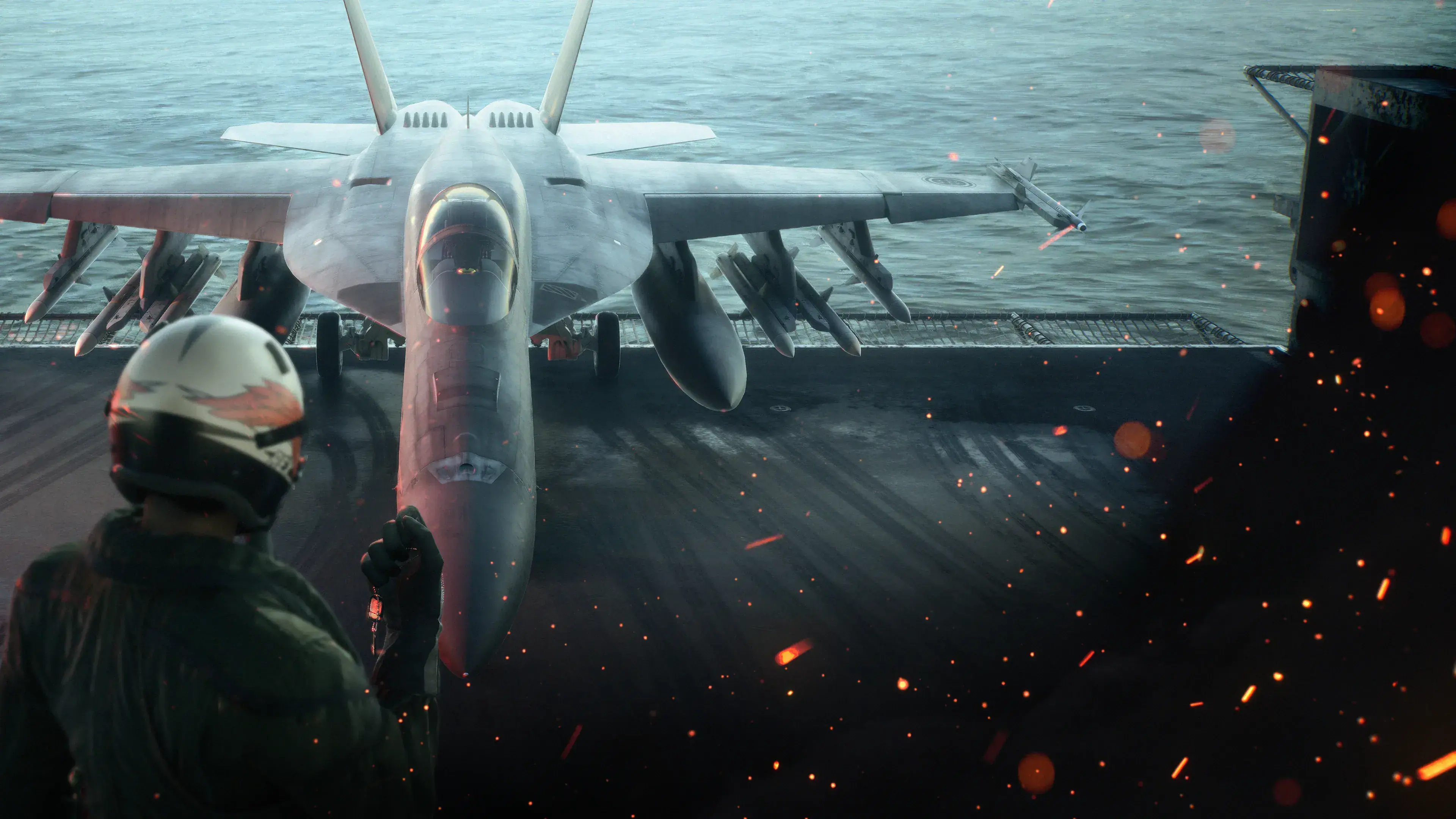
Ace Combat 8 Mission 16, “Singer,” asks you to find three disguised terrorist ships without attacking civilian traffic. Each correct vessel is a stationary container ship with three cranes on its deck and a sun emblem on its hull. Confirm both features before firing. Identify the emblem by its sun shape rather than relying on color alone.
Be ready for a second objective even if you sink the ships quickly. Destroying all three vessels is not a confirmed way to skip the UAV interception, so prepare to switch objectives immediately. When EXPLOSIVE UAV targets appear, stop searching the shipping lane and intercept them before they reach the critical altitude near the Space Elevator.
Return to the campaign mission list for surrounding operations; use the aircraft selection guide to balance stable inspection passes with UAV interception.
Version scope — October 7, 2026: This page was edited from supplied research. No numbered game build or independent playtest is recorded for this guide. Check the current in-game descriptions and your platform before applying build-sensitive conditions.
Mission 16 objectives at a glance
| Phase | Required action | Main risk |
|---|---|---|
| Search | Visually inspect stationary container ships | Mistaking a normal lock for positive identification |
| Identification | Find three cranes and a sun emblem on the same vessel | Relying on the disputed emblem color |
| Attack | Sink each confirmed disguised ship | Firing at civilian traffic or losing time on fighters |
| UAV interception | Destroy every EXPLOSIVE UAV | Chasing a low drone while a more advanced one continues climbing |
| Completion | Wait for confirmation that all drones are destroyed | Assuming the last ship or one UAV kill ends the operation |
Mission 16 is primarily an observation and target-priority test. Raw firepower helps once the UAVs appear, but it cannot replace careful identification during the opening search.
Prepare for the search and interception
Choose an aircraft you can control comfortably at low and moderate speeds. The search benefits from stable visual passes, while the possible UAV phase rewards acceleration and quick changes in altitude. A fast aircraft can shorten the distance between ship groups, but excessive speed may force repeated passes when you cannot inspect the deck and hull clearly.
Preserve enough standard missiles or air-to-air ammunition for the second phase. The exact launch behavior is disputed, so spending everything on unrelated fighters assumes a favorable outcome that the evidence does not guarantee. Multi-target or wide-area air-to-air weapons may help against clustered UAVs if your selected aircraft carries them, but no particular aircraft or special weapon is required by the current information.
Treat these as loadout priorities rather than guaranteed solutions:
- controllable speed for close visual inspection;
- enough acceleration to move between ship groups;
- reliable air-to-air weapons for climbing drones;
- sufficient ammunition to finish both mission phases;
- a configuration you can aim with while changing altitude.
The mission warns that the drones are being assembled in less than ten minutes. That countdown is a reason to search efficiently, not an invitation to fire on uncertain contacts.
Identify the disguised ships
Every valid ship combines two visible clues: three deck cranes and a sun emblem on the hull. Neither clue is sufficient by itself. A ship with the correct number of cranes but the wrong marking remains unconfirmed, as does a vessel whose emblem you can see without verifying its deck layout.
Do not use emblem color as the deciding feature. Community reports say that some objective text describes a color that does not match what players see, while the mission dialogue only requires a sun emblem. The safe method is to recognize the emblem’s shape and count the cranes.
Approach from an angle that exposes the deck and one side of the hull. A direct bow or stern view can hide the marking, while a very high pass may reveal the cranes but make the hull difficult to inspect. Reduce speed before the closest part of the pass, keep the vessel in view, and break away if you cannot confirm both features. One extra inspection is safer than testing an uncertain ship with a missile.
A weapon lock is not identification. The shipping lane contains civilian vessels, and the mission explicitly prohibits attacking them. Keep the trigger safe until the visual combination is clear and the game acknowledges the identified ship.
Search the shipping lane efficiently
The blockade has stopped maritime traffic, so the ships remain stationary while you inspect them. Use that fixed layout to search systematically instead of circling whichever contact happens to be nearest.
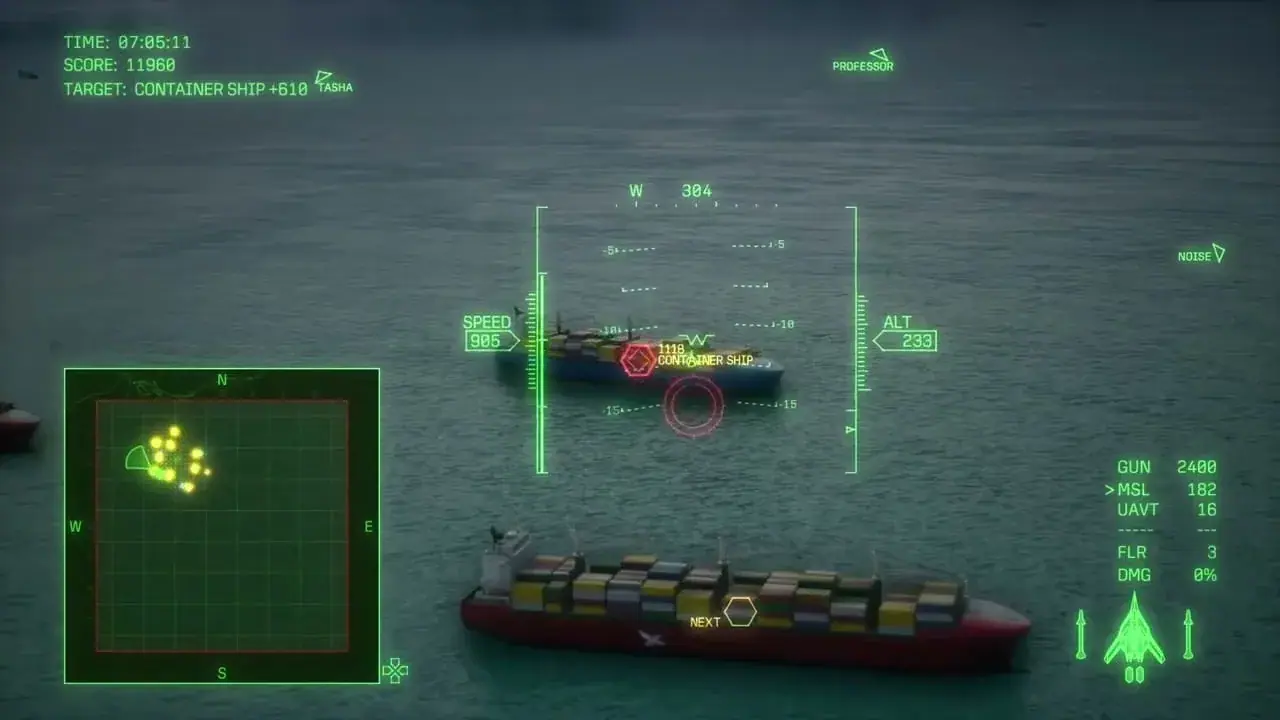
Use the overview to track which ship groups have already been checked.
A reliable search routine is:
- Zoom out enough to understand how the shipping contacts are grouped.
- Choose one edge of the traffic area and work across it in a consistent direction.
- Approach one container ship from the side rather than directly along its length.
- Count the cranes before committing to a closer pass.
- Check the hull for the sun emblem when the deck layout matches.
- Attack only after both clues are visible on the same ship.
- Continue toward an uninspected group instead of orbiting the sinking vessel.
- After the second confirmed target, concentrate on locating the final ship while remaining ready for a UAV launch.
This pattern prevents you from repeatedly checking the same civilian vessels. It also reduces abrupt turns that can leave you disoriented about which side of the lane has already been searched.
Do not assume that the targets always occupy a route you remember from a previous attempt. The community discussion contains claims about several possible routes and changing positions, but it does not establish a dependable spawn map. Use remembered positions only as places to check first, not as proof that a particular ship is hostile.
Manage enemy fighters without abandoning the search
Enemy aircraft may appear while the ships are still unidentified. They are usually a distraction from the time-sensitive objective rather than a reason to clear the entire sky before continuing.
Destroy a fighter when it is preventing a safe inspection, forcing constant defensive movement, or blocking your route to another ship group. Otherwise, evade it and continue the search. Long pursuits consume time, move you away from the stationary contacts, and make it harder to remember which vessels you have inspected.
The same rule applies to wingman support: use it to reduce pressure, but keep your own attention on the identification task. The mission does not require you to destroy every unrelated aircraft before dealing with the disguised ships.
Respond to the EXPLOSIVE UAV launch
The evidence does not support a promise that rapid ship destruction always prevents every UAV from launching. Some player reports describe an unavoidable initial launch, while another guide frames a fast search as a way to avoid or reduce the UAV problem. Because that conflict is unresolved, the dependable strategy is to prepare for the launch rather than build the run around skipping it.
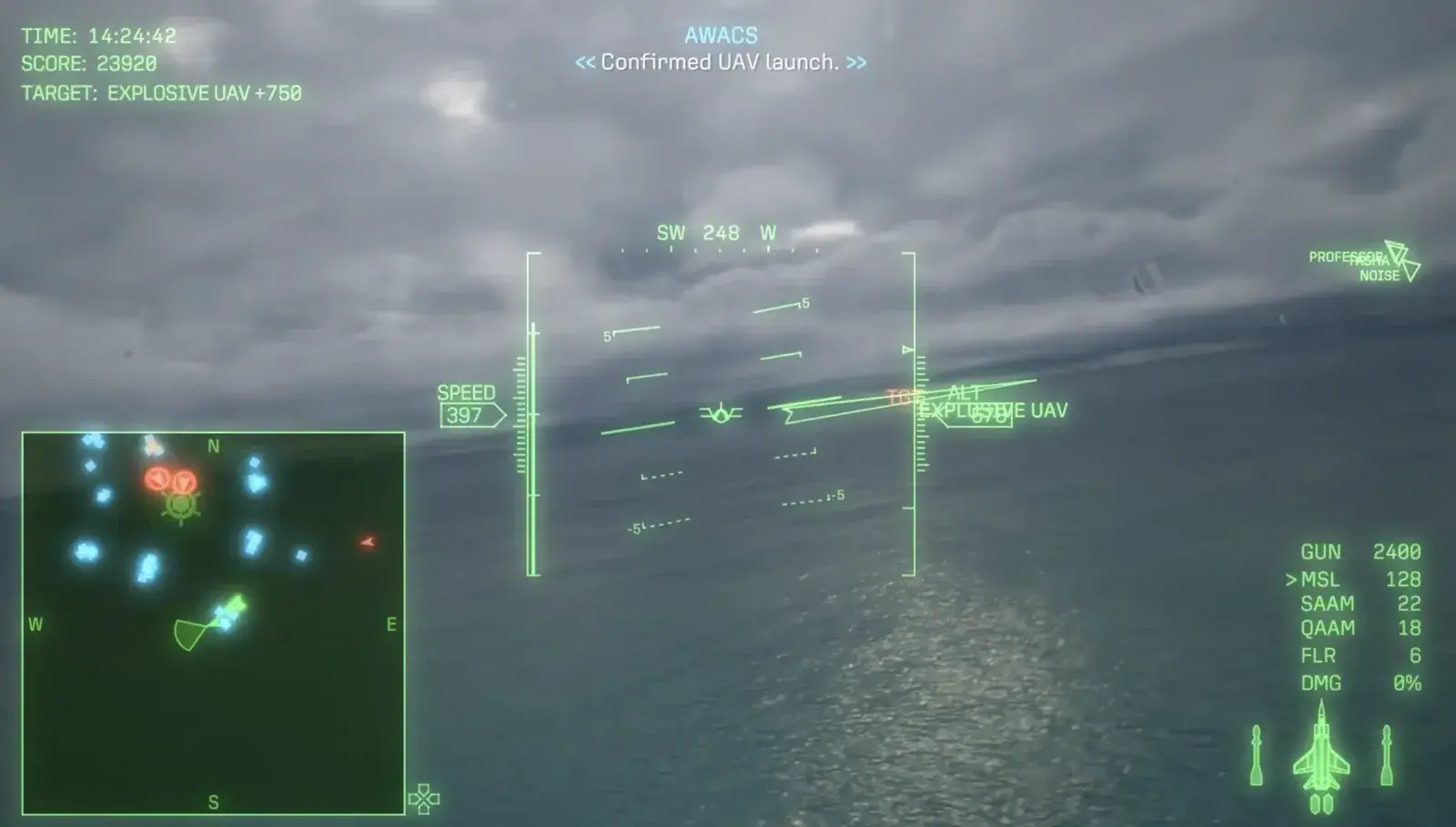
The launch callout marks the transition from ship searches to aerial threats.
As soon as the objective changes and EXPLOSIVE UAV targets appear:
- Stop inspecting ships unless the mission still explicitly requires a remaining vessel.
- Turn toward the UAV group and begin climbing with it.
- Scan the full group before committing to a prolonged chase.
- Prioritize the drone that is highest or furthest along its climb.
- Switch targets promptly after each confirmed kill.
- Continue until the operation announces that all drones have been destroyed.
Do not wait for the drones to spread out. A player report says they can be tightly grouped and follow a predictable path briefly after launch, creating an opportunity for multi-target weapons or a fast sequence of standard-missile shots. Treat that opening as a useful opportunity, not a guaranteed formation or guaranteed multi-kill.
Intercept the UAVs before the critical altitude
The UAVs climb toward the Space Elevator instead of fighting like conventional aircraft. Mission calls track their increasing altitude, so ordinary dogfighting habits can waste time. The objective is interception, not positioning for a prolonged turning battle.
Start with the most advanced threat. If one drone is substantially higher than the rest, attack it before a lower, easier target. After firing, look toward the next climbing contact instead of following the first target until impact. Confirm the kill through the HUD or mission call, then redirect immediately.
Use climbing turns that preserve speed. Pulling too aggressively can leave the aircraft slow beneath the UAV group, forcing another acceleration cycle while the drones continue upward. If a shot misses, decide whether a second attempt is immediately available. When the geometry is poor, changing to another threatening UAV may be better than remaining fixed on one target.
The game reports the remaining UAV count during the interception. Use those calls as a progress check, but continue scanning because the most dangerous contact may be separated vertically from the others. The mission is not secure merely because only one target remains.
Avoid three common errors:
- Chasing from directly behind for too long. The drones climb on irregular paths, so a poor tail chase can consume the remaining window.
- Starting with the lowest target. Easy kills do not help if a higher UAV reaches the elevator first.
- Turning back toward the ships too early. Once UAVs are airborne, their interception is the urgent objective unless the HUD explicitly says otherwise.
The decisive confirmation is the announcement that all drones have been destroyed. Do not infer completion from destroying the last disguised ship, seeing one UAV hit, or hearing only an intermediate remaining-count call.
Fix common Mission 16 problems
No ship matches the objective description
Ignore the disputed color wording. Search for the structural combination of three cranes and a sun emblem. Change your viewing angle so that the deck and hull can be inspected during the same pass.
The same vessels keep being inspected
Adopt a fixed sweep direction and move to a new cluster after every rejected or destroyed ship. Use the stationary traffic layout as a reference. Tight circles around one contact make the rest of the lane look less distinct.
A locked ship is not becoming the objective
A lock alone does not establish that the vessel is hostile. Break away and check both visual clues. Do not fire merely to discover whether the ship was correct.
UAVs launch after a fast search
This does not prove that the run is lost. The interception can still occur as a normal objective transition after the search phase. Switch to the UAVs immediately and follow the altitude-priority plan.
One UAV keeps escaping upward
Stop attacking lower contacts first. Identify the highest surviving drone, climb with enough speed to obtain a clean shot, and avoid wasting the approach on unrelated fighters. If a special weapon cannot acquire a useful firing solution, standard missiles remain preferable to waiting without attacking.
Replay and rank considerations
For a normal clear, prioritize correct identification and a controlled UAV interception. Do not deliberately delay the search based on an unverified reward strategy.
For rank attempts, the current information supports only general principles: mission evaluation can consider completion time, destroyed enemies, bonus targets, damage, and mission-specific performance. It does not provide a verified Mission 16 S-rank threshold. Complete the required objectives efficiently, avoid civilian fire, minimize damage, and avoid unnecessary detours, but do not present any particular score or time as guaranteed.
Mission 16 is also discussed as a quick MRP replay, yet the available reports provide inconsistent personal returns and conditions. A high payout from one run does not establish the best income per minute for every aircraft, difficulty, loading time, or failure rate. The repeatable value of this guide is the short search routine: verify both ship features, move directly to the next group, and remain equipped for the UAV phase.